Serial number: 2029102
Administrative document: None - No technical inspection certificate
Manufacture: from 1971 to 1985
From 1969, the A112 was produced to compete with the Austin Mini launched in 1965, whose production license for Italy was held by Innocenti. From 1971, a more sporting version signed Abarth supported the standard model. Designed by Dante Giacosa and styled by Fiat Centro Stile for its aesthetic appeal. With the assistance of Carlo Abarth, head of Fiat and Lancia's competition branch, the engine was designed.
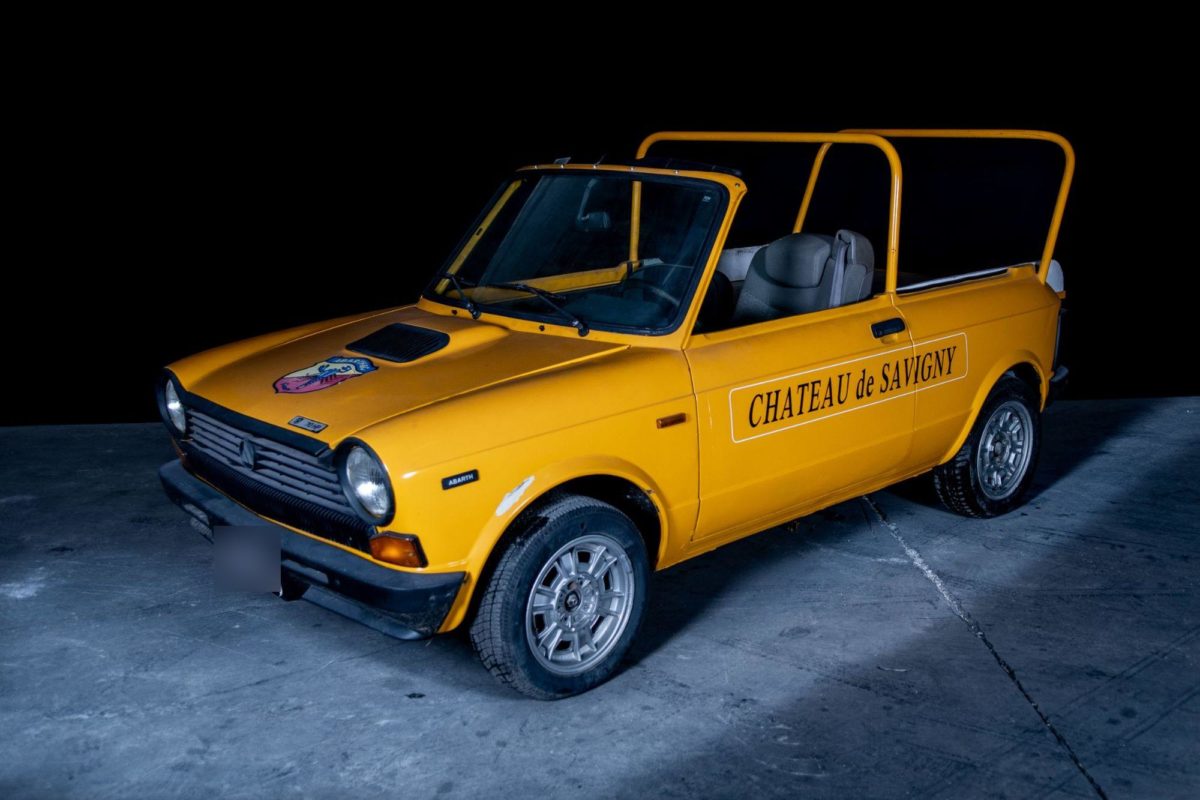
From the collections of Château de Savigny, our vehicle was used for travel within the estate grounds. It has therefore been modified and is not homologated. It is sold as non-running.
From 1969 onwards, the A112 was produced to compete with the Austin Mini launched in 1965 and licensed for production in Italy by Innocenti. From 1971 onwards, a sportier version with the Abarth name was produced alongside the normal model. Designed by Dante Giacosa and dressed by the Centro Stile Fiat for the aesthetic aspect. The engine was designed with the help of Carlo Abarth, head of the Fiat and Lancia racing branch.
Our vehicle, which comes from the Château de Savigny's collections, was used for travel in the park. It has therefore been modified and is not homologated. Non rolling.
More about
This text was generated using natural language processing technology and may contain inaccuracies.
The 1985 Autobianchi A112 presented here represents a fascinating chapter in Italian automotive history, specifically within the context of the Château de Savigny's private collection. Produced between 1971 and 1985 to compete directly with the Austin Mini, this compact car was engineered under the visionary direction of Dante Giacosa, who also designed the iconic Fiat 500. The aesthetic appeal was handled by Fiat's Centro Stile, while the engineering prowess came from Carlo Abarth, head of Fiat and Lancia's racing division, ensuring a robust mechanical foundation.
This specific example is distinguished by its unique history as a non-homologated vehicle modified for exclusive use within the park grounds of the Château de Savigny. The listing notes that it was utilized for travel within this private estate, resulting in modifications that preclude standard road registration. Consequently, the vehicle is sold strictly as 'non roulant' (non-running), reflecting its status as a historical artifact rather than a street-legal daily driver.
Mechanically, the A112 platform offered a front-wheel-drive layout with a transverse engine, a revolutionary design for its era that allowed for excellent packaging and handling dynamics. While the specific engine displacement is not detailed in the listing, the collaboration with Carlo Abarth suggests a focus on performance characteristics typical of the sportier iterations that emerged from 1971 onwards. Finished in white with a manual transmission, this unit stands as a rare piece of automotive heritage, offering collectors a tangible link to the era when Innocenti licensed production rights to create Italy's answer to the British classic.

 France